
Leave Encashment UAE: Accurate Calculations & Compliance (2025 Guide)

For finance and HR leaders in the UAE, few topics generate as much confusion, or as many disputes, as leave encashment. It seems simple on the surface: employees either take their annual leave or they are paid for unused days. Yet the reality is more nuanced. The distinction between full wage when leave is taken and basic wage when leave is encashed, the carry-forward rules, and the 14-day settlement deadline can easily trip up even seasoned payroll teams. Add to this the special regimes in DIFC and ADGM, and compliance becomes a delicate balancing act.
This guide cuts through the complexity, showing you exactly how to calculate leave encashment in 2025, how it interacts with end of service benefits (EOSB), and where employers most often go wrong.
What “Leave Encashment” Means in the UAE
Annual leave entitlements are a cornerstone of employment law in the UAE, but how those days are managed is equally important. Under the Federal Decree-Law No. 33 of 2021 and its Executive Regulations, employees accrue a right to annual leave, and employers have obligations not only when leave is taken but also when it is carried forward or converted into cash.
Put simply, leave encashment is the payment made to employees in lieu of unused annual leave. This usually happens when an employee exits the business, though it can also occur during service if the company policy allows.
Key rules to note:
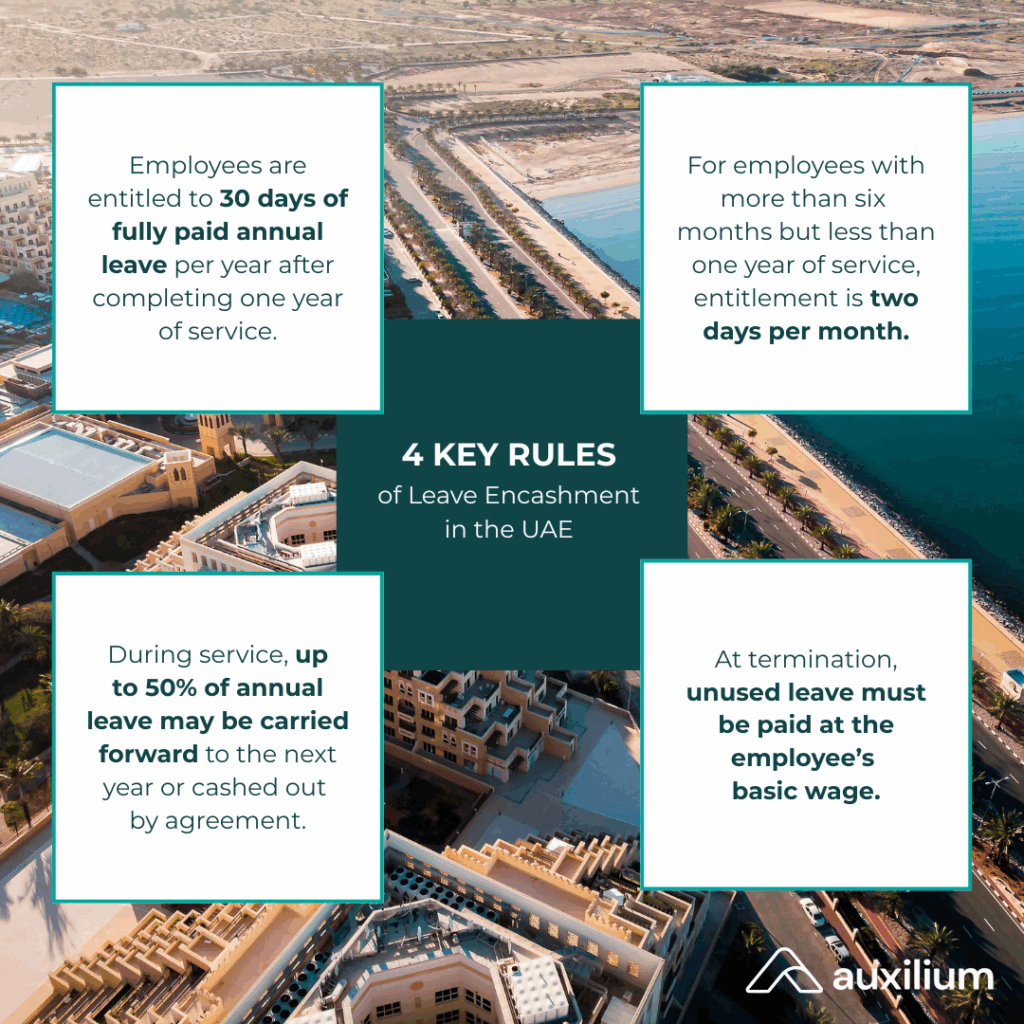
- Employees are entitled to 30 days of fully paid annual leave per year after completing one year of service.
- For employees with more than six months but less than one year of service, entitlement is two days per month.
- During service, up to 50% of annual leave may be carried forward to the next year or cashed out by agreement.
- At termination, unused leave must be paid at the employee’s basic wage.
This distinction, between full wage when leave is taken and basic wage when it is encashed, is the foundation of correct calculations.
The Calculation Framework: Full Wage vs. Basic Wage
The most common source of error lies in mixing up full wage and basic wage. Both terms sound interchangeable, but legally they are not.
- Full wage includes basic salary plus fixed allowances. It applies when an employee actually takes their leave.
- Basic wage excludes allowances. It is the benchmark for cash-in-lieu payments and for end-of-service gratuity.
For payroll teams, this means building two distinct workflows: one for leave actually taken, and one for leave encashed.
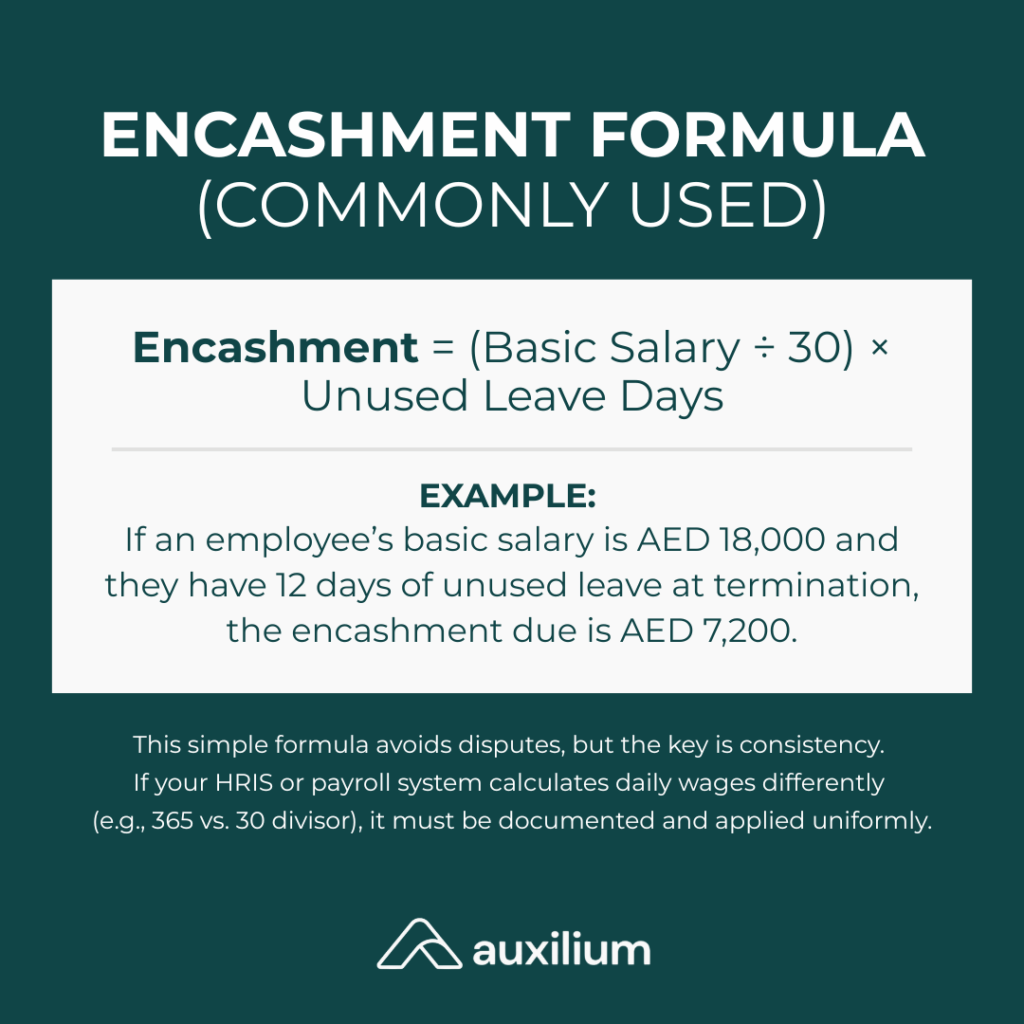
Encashment formula (commonly used):
Encashment = (Basic Salary ÷ 30) × Unused Leave Days
Example: If an employee’s basic salary is AED 18,000 and they have 12 days of unused leave at termination, the encashment due is AED 7,200.
This simple formula avoids disputes, but the key is consistency. If your HRIS or payroll system calculates daily wages differently (e.g., 365 vs. 30 divisor), it must be documented and applied uniformly.
End of Service Benefits UAE: The Connection
Leave encashment doesn’t exist in isolation—it connects directly with end of service benefits (EOSB), one of the most sensitive aspects of payroll in the UAE. Both rely on the basic wage as the reference point, but they are calculated separately and must not overlap.
Under MoHRE rules:
- Employees earn 21 days’ basic wage per year of service for the first five years.
- From year six onward, they earn 30 days’ basic wage per year.
- The gratuity is capped at two years’ basic wage.
At termination, employers must settle all outstanding dues, including salary, leave encashment, and gratuity, within 14 days. Failure to meet this deadline risks fines, employee complaints, and damage to the company’s reputation.
The practical challenge is ensuring the payroll team reconciles these elements cleanly: leave encashment for unused leave days, gratuity for length of service, and no duplication between the two.
Free-Zone Watchouts: DIFC & ADGM
While the MoHRE regime governs mainland UAE, employers operating in DIFC or ADGM face entirely different compliance landscapes. Many payroll errors happen because finance teams apply mainland rules inside these centres.
- DIFC: Since 2020, DIFC has replaced gratuity with the DEWS savings scheme, requiring employers to make monthly contributions to employee investment accounts. The gratuity formula no longer applies here.
- ADGM: From 1 April 2025, new Employment Regulations introduce an EOSB savings-scheme model. Employers must prepare for a transition from traditional gratuity to a contribution-based approach.
The lesson is clear: check the jurisdiction. A multinational in Dubai may have staff under three different labour regimes at once, MoHRE, DIFC, and ADGM. Treating them the same invites compliance risk.
How to Calculate Leave Encashment: Step-by-Step
Payroll accuracy depends on following a disciplined process. The steps below provide a structured roadmap:
- Confirm the jurisdiction (mainland MoHRE vs. DIFC vs. ADGM).
- Check the employee’s basic salary and the date of last adjustment.
- Review the leave ledger for unused days and entitlement dates.
- Apply carry-forward rules (≤50% during service). At termination, all unused leave must be paid.
- Use the correct formula: Basic ÷ 30 × unused days.
- Reconcile with EOSB to prevent double counting.
- Process payment within 14 days of termination.
- Archive documentation (contracts, ledgers, approvals, WPS proof) for audit readiness.
Following this sequence ensures compliance and protects both employer and employee in case of dispute.
Common Pitfalls and How to Avoid Them
Despite clear rules, mistakes are frequent. Companies often pay encashment on full wage instead of basic wage, over-carry leave beyond the 50% limit, or delay final settlements past the 14-day deadline. Others misapply mainland rules in DIFC or ADGM, creating costly corrections.
Each of these pitfalls can be avoided by embedding compliance directly into HR and payroll systems. Policies should clearly define wage components, HRIS should timestamp leave entitlements, and treasury should automate settlement triggers. In short: compliance must be operationalised, not left to manual checks.
Auxilium - Your Trusted Partner in the GCC
For businesses expanding in the GCC, compliance with leave encashment and EOSB rules is just one part of a much bigger picture. Visa quotas, payroll deadlines, and free-zone variations make it nearly impossible for in-house teams to stay ahead of every regulation.
That’s where Auxilium comes in. As the leading Employer of Record (EOR) in the GCC, Auxilium manages contracts, payroll, visa processing, leave encashment, and end-of-service obligations, not just in the UAE but across Saudi Arabia, Kuwait, Oman, Bahrain and Qatar.
Clients across the construction, tech and recruitment industries have trusted Auxilium to onboard staff seamlessly across multiple jurisdictions, maintain 100% compliance, and avoid costly delays caused by regulatory red tape.
If you are planning headcount in the UAE, Auxilium can take on the compliance burden, ensuring your leave encashment and EOSB obligations are met accurately and on time. Book a free consultation to start expanding with confidence.
Frequently Asked Questions
Leave encashment in the UAE is calculated based on the employee’s basic salary (excluding allowances). The formula is (Basic Monthly Salary ÷ 30) × Number of Unused Leave Days. Employees are entitled to payment for all accrued but unused annual leave upon resignation or termination, as per UAE Labour Law.
Under Federal Decree-Law No. 33 of 2021, employees who complete one year of service in the UAE are entitled to 30 calendar days of paid annual leave. Those with six months to one year of service earn two days per month. Leave salary must be paid before the leave begins, and unused leave may be carried forward or encashed with employer approval.
If you do not use your annual leave in the UAE, you remain entitled to those days and may carry forward up to half with your employer’s consent. If your employment ends, the employer must pay you cash compensation for unused days based on your basic salary. UAE law prohibits employers from denying leave use for more than two years.



Schedule a Free Consultation
Tell us what you’re looking for and we’ll handle the rest.
Let's talk!
Please provide your details, and one of our specialists will promptly reach out to you.