
Employer of record agreements in the UAE and what to check before signing


Quick answer: A UAE employer of record agreement should explain how your business and the EOR will work together to support your employees. Review the service scope alongside the employment contract template, payroll schedule and approvals process. Clear responsibilities give the hiring team and the employee a consistent experience from the start.
A well-structured EOR agreement turns a hiring decision into an organised employment service. It connects the proposed role and start date with the people who will coordinate onboarding, administer payroll and respond to employment questions and requests.
For a business preparing its first hire or expanding a team, that clarity supports day-to-day decisions. This guide explains the main parts of an agreement and how to use them to build a productive working relationship with your EOR.
Key takeaways
- Read the commercial agreement and employee contract template together, and confirm which entity is the legal employer.
- Separate payroll funding, employment costs and provider fees so finance can plan accurately.
- Give routine decisions an owner and a response time.
- Document employee support, data access and exit arrangements before onboarding begins.
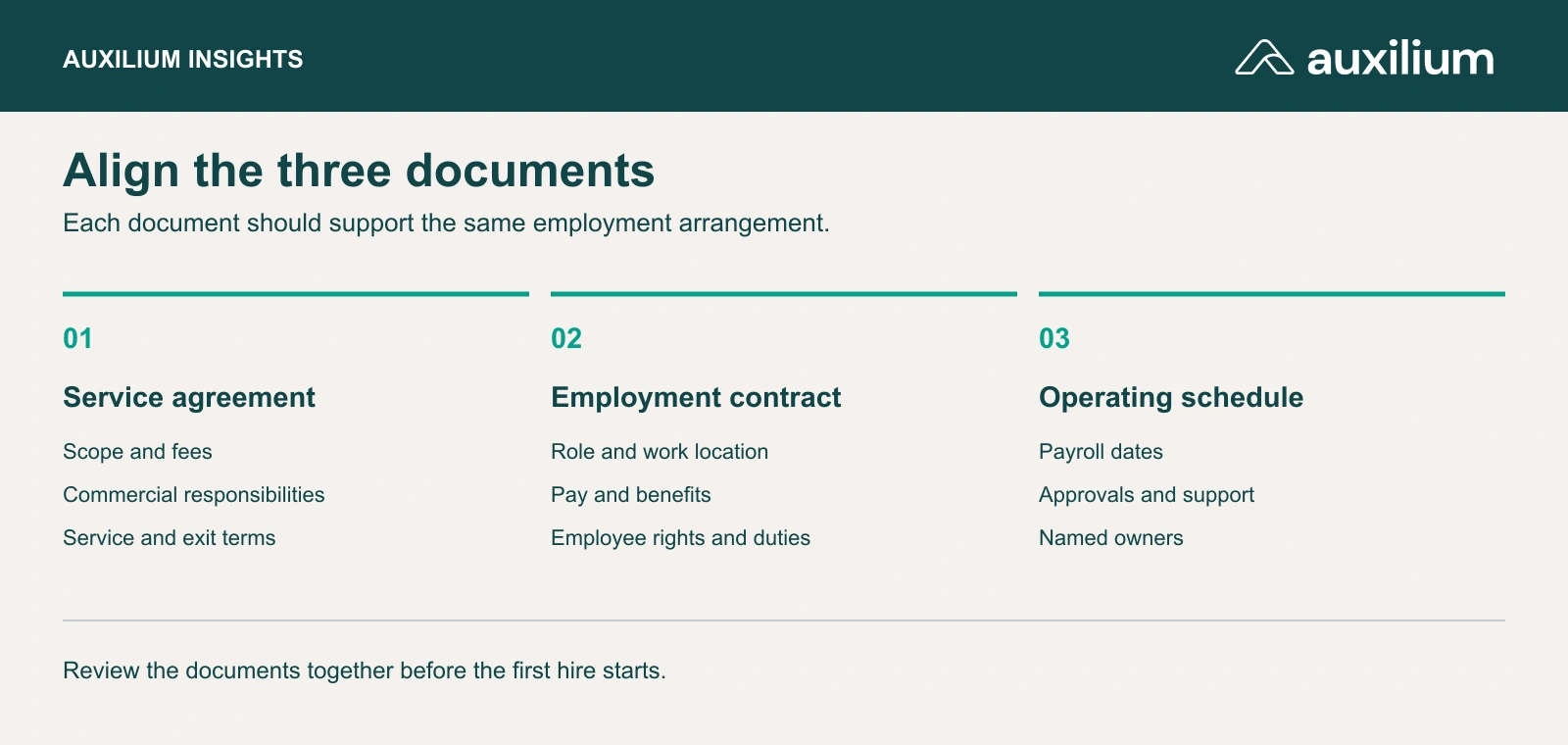
Start with the three documents
The service agreement governs the relationship between your company and the EOR. It should explain the scope, charges, responsibilities, service standards and commercial termination terms.
The employment contract governs the relationship between the legal employer and the employee. The UAE Government’s guidance on job offers and employment explains the connection between the offer, contract and permit process. Pay, role and employment terms should be aligned across the documents used for the hire.
The operating schedule turns those commitments into a monthly process. It can be a contract attachment or an agreed procedure, but it needs named owners and dates. A payroll obligation is easier to deliver when everyone knows who supplies the inputs and who approves the final calculation.
Confirm the employer and the scope of service
Ask which legal entity will employ the person and which entity is signing the service agreement. Where another organisation is involved, request a clear explanation of its role and how accountability passes between the parties.
The scope should identify the country, work location and role being supported. Agree the relevant employment framework and authorisations with the provider so the documentation reflects the actual assignment.
Record which services are included: employment administration, permit support where applicable, payroll, insurance administration, employee queries, requests and departures. If recruitment, equipment, travel or dependent support is outside the scope, that needs to be clearly understood by both parties.
Align the employment arrangement with your company’s business activities and the applicable national workforce requirements. Record which team is responsible for each area of compliance, including any separate commercial or tax advice relevant to the business.
Make the monthly funding cycle visible
Agree the payroll input deadline, approval date and funding date, working back from the statutory pay date. A shared calendar also shows managers when salary changes need to be submitted.
Under MOHRE’s Wage Protection System (WPS), private sector wages for each month are due on the first day of the following month, and MOHRE monitors payments through the system. Confirm how the provider pays through WPS, records completion and responds to payroll queries.
Ask for a clear breakdown of the agreed service fee, employee remuneration and any applicable setup items. This helps finance distinguish service delivery from the amounts administered on behalf of employees. Record the agreed payment terms so the monthly process is easy to follow.
Agree who does what when something changes
A responsibility schedule helps the service adapt as the team grows. It gives managers a clear process for salary reviews, leave requests, employee questions and changes to an assignment.
The list below is a starting point. These are suggested operating allocations to agree with your provider, not a statement that every EOR uses the same model.
- Monthly payroll. Your team supplies: approved changes and timely funding. EOR action to agree: calculation, payment administration and confirmation.
- Salary or role change. Your team supplies: business approval and proposed terms. EOR action to agree: review and employment documentation before implementation.
- Employee query. Your team supplies: workplace context where needed. EOR action to agree: named contact, response target and escalation route.
- Assignment ending. Your team supplies: reason, proposed date and relevant records. EOR action to agree: guidance on the required process and itemised employment costs.
Ask for response targets that describe something measurable. A target for acknowledging a query is different from a target for resolving it. Authority decisions and third-party processing should be distinguished from actions the provider controls.
Plan support throughout the employment lifecycle
Include an agreed process for assignment changes and departures. The commercial notice arrangements and employment steps should be coordinated so the employee receives clear communication and the relevant entitlements are handled correctly.
Keep employment history, leave balances, benefits records and other relevant information organised throughout the assignment. An agreed handover process helps the teams maintain continuity when responsibilities or employee circumstances change.
Employee records also need a clear home. Agree who can access which information, how it is shared securely and what is retained or returned when the service ends. Request an export format your HR team can actually use.
A worked example of a quarterly bonus
Illustrative scenario, not an Auxilium client case study. A software company hires two UAE employees through an EOR and includes a quarterly bonus in the agreed package. The client and EOR use the onboarding discussion to establish how the bonus will move from manager approval into payroll.
They record the approval date, supporting information, payment timing and employee communication. They also agree how an update received after the normal input deadline will be handled. The manager, finance team and employee can then follow the same plan.
Where Auxilium fits
Auxilium’s UAE employer of record service supports local employment and administration while your team directs the work. Bring the proposed roles, locations, pay structure and approval process to the discussion so the service scope can reflect how your business operates.
Reviewing an EOR agreement? Send us your proposed headcount and start dates and we will confirm the employment support your team needs. Speak to our team.
Disclaimer
This article provides general commercial guidance. Employment requirements depend on the arrangement and jurisdiction; obtain advice on your specific contract before signing.
Frequently Asked Questions
No. Your company’s service agreement defines the commercial engagement with the provider. The employee’s contract sets the employment terms with the legal employer. They should be consistent, but they serve different relationships.
It should describe the employment services, responsibilities, agreed fees, payment terms and employee support arrangements. It should also explain how changes are approved and who the client and employee can contact.
Coordinate the timetable with the EOR, including employee communication, employment documentation and any entitlements due. The end of the client assignment and the completion of employment formalities need to be managed together.



Schedule a Free Consultation
Tell us what you’re looking for and we’ll handle the rest.
Let's talk!
Please provide your details, and one of our specialists will promptly reach out to you.